







England have won three of their four UEFA Nations League games so far, beating both Czech Republic (twice) and Croatia since their 3-2 loss against Spain.
A big area of experimentation so far this international break for Thomas Tuchel has been in the midfield and full-back departments.
While Elliot Anderson has started all three games, Myles Lewis-Skelly has started twice in midfield alongside the City star, with Nico O’Reilly, Lewis Hall, Jarell Quansah and Trent Alexander-Arnold playing in the full-back positions for various games.
But perhaps the most interesting of them all, Tuchel gave Alex Scott his England debut, coming from the bench against Czech Republic before getting his first start in England’s 7-0 demolition of Croatia.
The 23-year-old midfielder has been in fine form for Bournemouth over the past 12-months, but why could he be the answer to Tuchel’s control problem moving forwards?
In this article, we’ll cover
Tempo-setting and build-up solutions
A big topic of discussion among England fans this summer was about the balance of the team. With Anderson and Declan Rice in midfield, many suggested Tuchel’s side lacked a range of passing.
Compound this with the full-back selections, whose best attributes largely revolved around physical and defensive traits, and you begin to understand England may not have given themselves the best in-possession foundations to thrive, or atleast the profiles within the squad to change dynamics when needed.
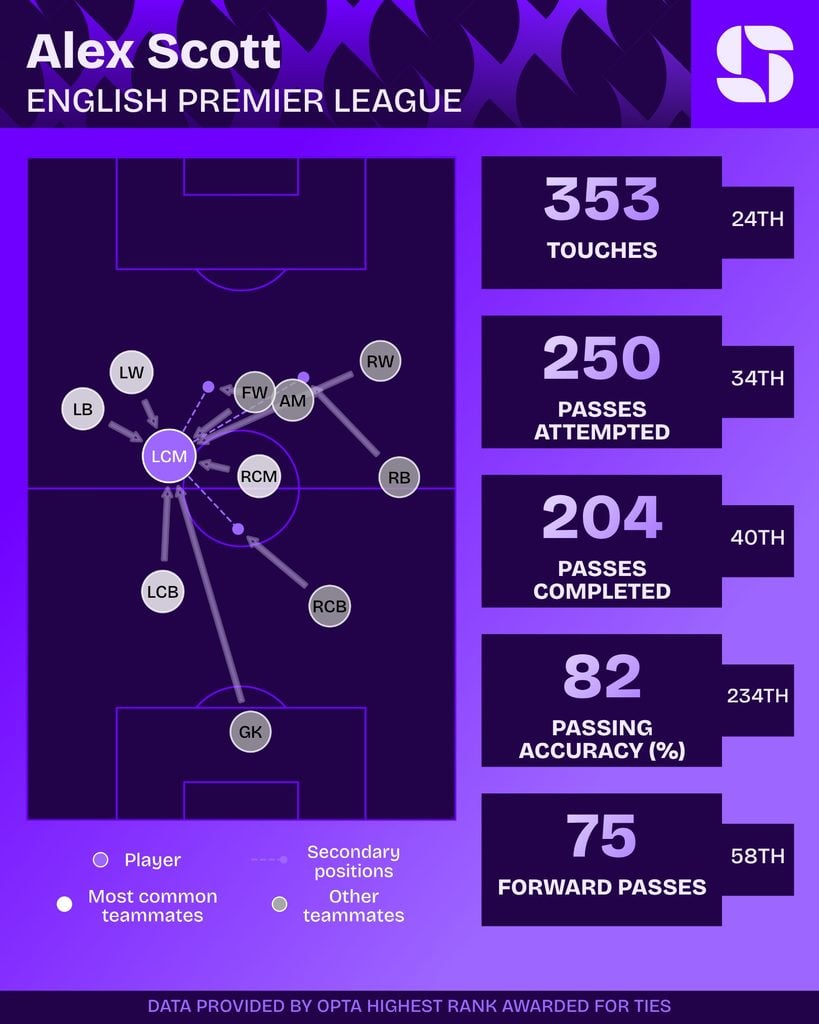
While many speak of the passing ability when discussing the midfield issues that England have, it is often dismissing the control issues and tempo issues that stem from this.
Scott was one of the midfielders left at home when Tuchel selected his World Cup squad in the summer, with Adam Wharton also missing out.
Against Argentina in the World Cup semi-final, it was clear England lacked the appropriate profiles to get on the ball, afford moments of control and look to manage the game by slowing it down.
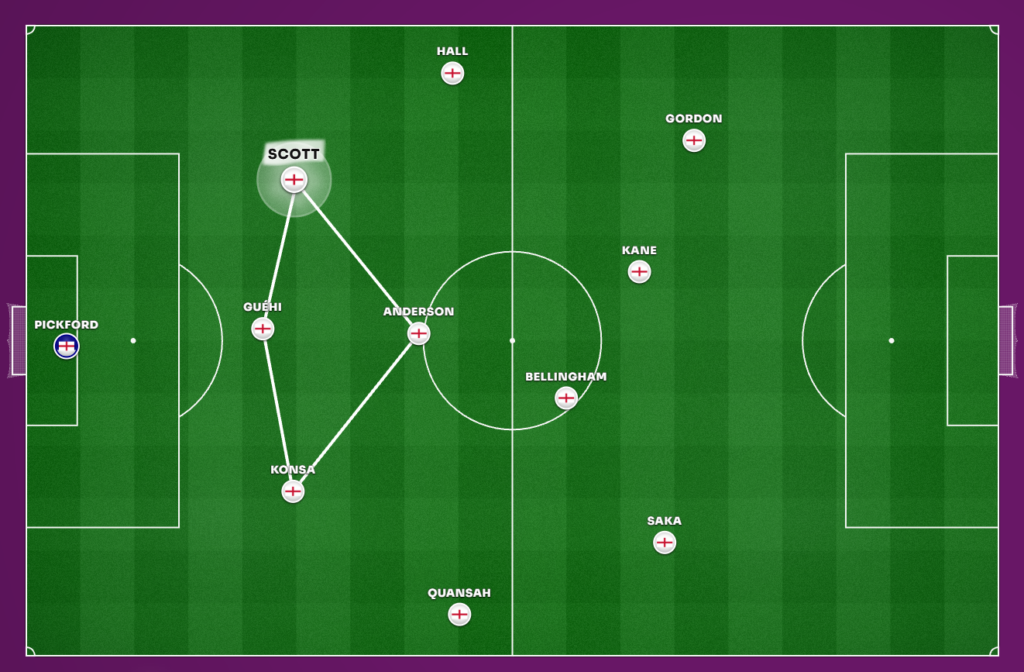
One of the main qualities Scott brings to this England group is his composure on the ball in all phases of play, whether that be dropping into the first line or receiving as a single or double pivot with his back to play. This allows him to help control the tempo, both with circulation passes and lateral carries to evade pressure and retain possession.
Scott never looks rushed in the build up, comfortable at different rhythms to control the flow of the game. The clean execution of his actions helps to accelerate/decelerate possession phases, consistently making good decisions which contribute to the next sequence of passes that follow.
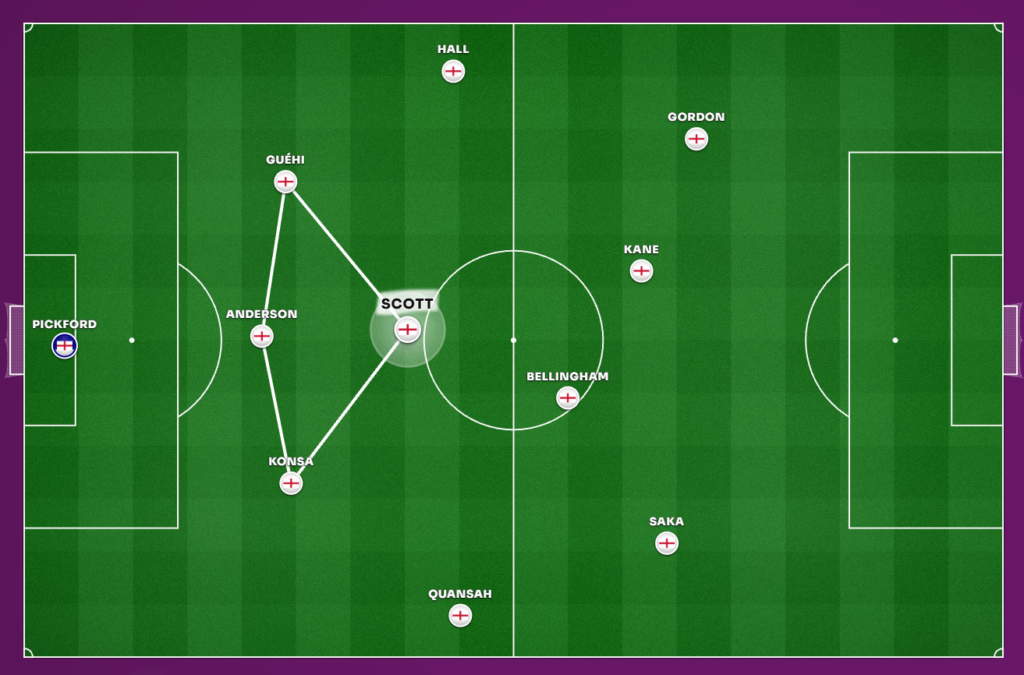
Tuchel himself stated “He is just the complete package. He gave us a lot of mobility and a lot of variety” when speaking about Scott’s full debut against Croatia.
The mobility Tuchel mentioned refers to Scott’s ability to operate at different heights on the pitch, often making clever movements to ensure he is always an option to receive and combine with his teammates.
Scott is invaluable to the build-up because of these traits, managing and controlling the flow of the game, finding solutions to bypass pressure and arriving in advantageous positions on a regular basis due to his work.
Defensive resolve
But Scott isn’t just a luxury player on the ball, infact, the other area of his game which was also praised by Tuchel was his workrate off the ball.
This season, Scott has won the most ground duels in the Premier League with 30, while England partner Elliot Anderson sits second in this metric on 29.
His industrious nature allows him to consistently arrive in 50/50 duels, putting himself in active positions to regain possession and disrupt the opponent.
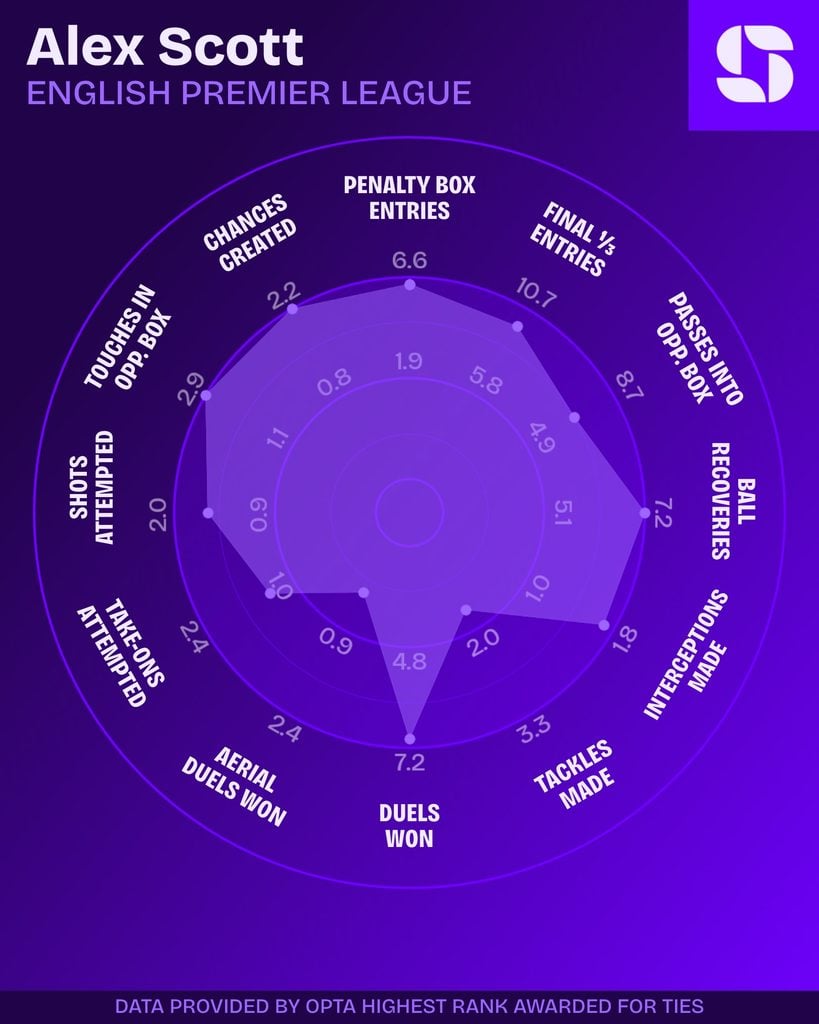
Scott is a valuable part of a rest defence unit for his workrate out-of-possession, often alert to danger in transition, putting out fires before they can fully start.
You can utilise his defensive skill set when pressing in a more man-oriented fashion, as Scott has the durability and stamina to cover larger distances, arrive with good timing and decelerate on approach in order to put good pressure on the ball and force mistakes/turnovers.
Having Scott at his disposal means Tuchel is able to get a more highly technical midfielder into the team to build a more connective and controlled approach in-possession, while not neglecting the need for athleticism and defensive quality in midfield.
Untapped potential
Lastly, you have the most untapped phase of Scott’s game as things stand, which is when he finds himself in the final third.
As mentioned earlier, Scott is extremely comfortable at all heights/depths, having the ability to operate not only as a number six or number eight, but also as a number 10.
Scott’s ability to operate further forward, in tighter spaces and between the lines means he can often accelerate play, either driving the ball into the final third himself, or combining with his teammates to arrive in advanced areas.
He is smooth on the ball, great at playing against momentum and is a player that thrives connecting and combining with others, which not only helps him, but allows other forwards to trust him with the ball and build a synergy with him to find solutions.
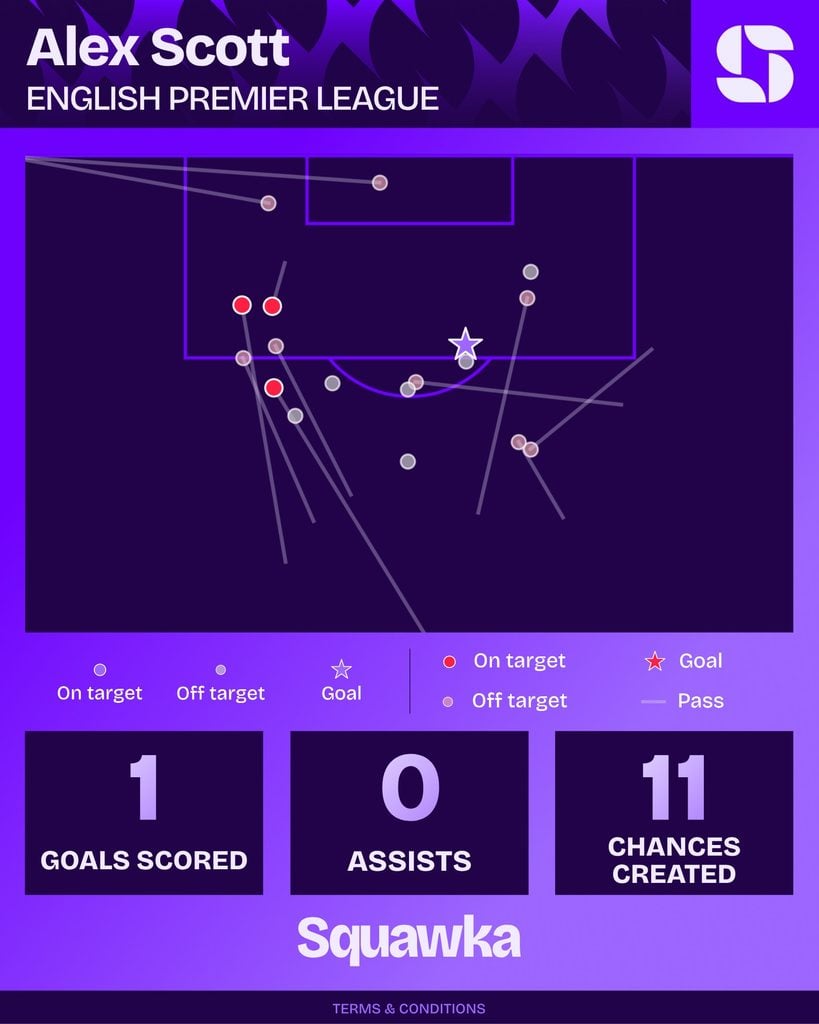
Scott loves looking for advantages he can create with give and go scenarios, following his pass and looking to continue his run to offer the next passing option for his teammate.
In these moments, Scott can showcase his ability to play against momentum, whether that be carrying in one direction before combining to come back the other way, or using deception to play a pass back against the opposition momentum, which can often lead to advantages in the final third.
His final product however is the next piece of the puzzle, as his ability to create shots for others and himself inside the opposition box isn’t his biggest strength.
When it comes to penetration around the box, Scott has more than enough quality in his locker to find more creative solutions to find access to the opposition box.
Considering he finds himself in these positions a good amount due to his ability to both carry the ball and progress into the final third, but also to combine with others in close proximity and gain territory into the opposition half, Scott’s next step is becoming more effective in those areas once he arrives there, which playing for England with the likes of Harry Kane and Jude Bellingham is bound to help.