






The 1994 World Cup in the United States was FIFA’s attempt to not only change football, but to repackage it.
This bold experiment saw NFL stadiums borrowed, kick-off times majorly adjusted for television, and the tournament arriving wrapped in a spectacle which gave a sense that the global game had been dropped into a completely different cultural climate.
So let’s cast your minds back to 22 years ago with a list of 11 things you forgot about the last World Cup hosted by the USA as we await World Cup 2026.
Diana Ross misses and still opens a World Cup
There are opening ceremonies, and then there is whatever this was.
USA ’94 began with Diana Ross stepping up to take a ceremonial penalty in front of a packed Chicago crowd. The idea was simple: walk up, score, and split the goal in two as part of a staged spectacle. Instead, she missed it entirely.
The goal still fell apart in theatrical fashion, but the miss itself became instantly iconic. It set the tone for a tournament that would be big, bold, and occasionally completely unhinged.
The first ever indoor World Cup match
Global football conjures up a myriad of unique venues, however, these are completely different to play under a roof.
USA vs Switzerland in Detroit was the first ever World Cup match played indoors, inside the Pontiac Silverdome. No weather, no open sky, no natural light – just artificial conditions and a pitch that felt more NFL than FIFA.
The ball echoed off the roof, the atmosphere felt compressed, and it underlined just how different this World Cup was going to be.
Roger Milla becomes a World Cup immortal
Age is just a number. And there is no better example of that than cult hero Roger Milla refusing to leave the stage.
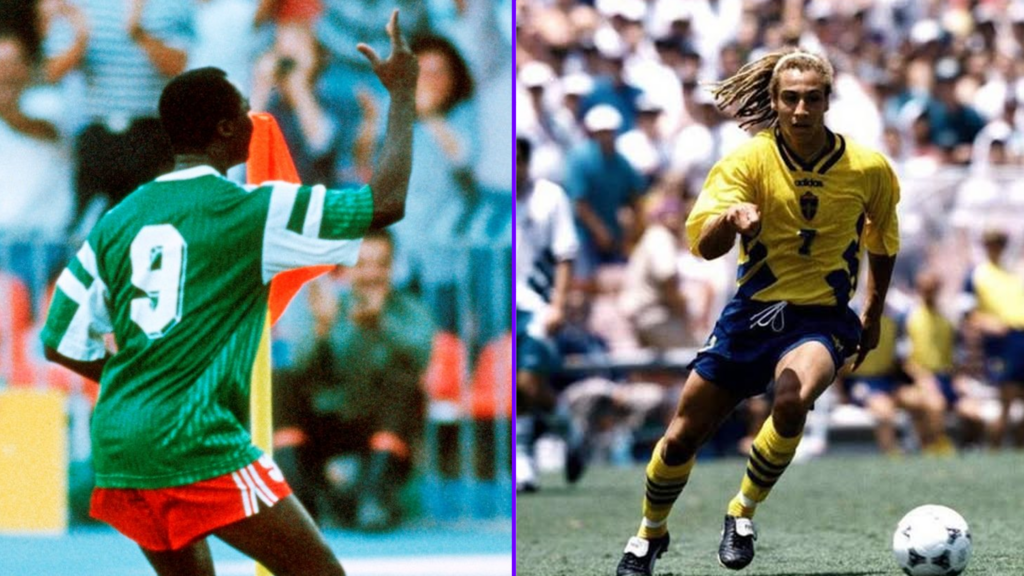
At 42 years old, Milla became the oldest player and goalscorer in World Cup history, coming off the bench for Cameroon and still celebrating goals with his trademark corner-flag dance.
It felt less like a comeback and more like a ritual. A player from a different era appearing in a tournament that was already starting to feel modern in every other way.
The backpass rule changes everything
The sport has got used to rule tweaks over its long-spanning history, but few have reshaped how football is played like the introduction of the backpass rule.
USA ’94 was the first World Cup to feature the rule, banning goalkeepers from handling deliberate passes from teammates. It sounds small, but it forced defenders to think differently under pressure and killed off entire patterns of time-wasting.
Suddenly, keepers had to become footballers. The pace of the game subtly shifted, and modern possession football took another step forward without most fans even noticing.
Some moments shroud the sport
Andrés Escobar’s deflection against the United States should have been an unfortunate yet forgettable moment. Instead, it became one of the most tragic moments in football history, proceeded by his murder five days later.
The match itself – USA’s 2-1 win over Colombia – was historic for American football. But it is forever shadowed by what came after, turning a group stage game into something far heavier than sport.
Ireland beat Italy in one of the great World Cup shocks
This arguably remains the crowning achievement for Ireland on the global stage, certainly in terms of victories.
Ray Houghton’s early strike against Italy in New Jersey was enough to seal a 1–0 win over the reigning finalists in the opening match of Group E. Ireland then defended for their lives, holding one of the most technically gifted teams in the world to a standstill.
No flair, no possession dominance – just discipline and sheer stubbornness. It remains one of Ireland’s greatest footballing nights.
Oleg Salenko scores five in a single World Cup match
Forget braces or hat-tricks. World Cup Golden Boot winner Oleg Salenko rewrote record books in a single 90 minute session during the group stage.
Salenko scored five goals for Russia against Cameroon, a record that still stands for most goals in a single World Cup match by one player.
It came in a 6–1 win that felt less like a group game and more like a statistical glitch. Even now, it reads like something that shouldn’t be possible at international level.
Sweden quietly become the tournament’s most dangerous attack
This golden generation, positioned as an underdog before a ball was kicked, defied all expectations in the summer of 1994.
Sweden finished third, and, remarkably, were the tournament’s highest scorers (15). With Tomas Brolin, Martin Dahlin and Henrik Larsson emerging, they combined efficiency with attacking prowess.
They were never the headline act, but they were one of the most consistently dangerous sides in the entire competition and the true definition of a tournament dark horse.
Heat turns the competition into survival of the fittest
Playing elite sport in extreme American heat is another factor to consider for this summer’s stars.
Kick-offs in the middle of the day, often in punishing conditions, led to slower matches, exhausted players, and tactical conservatism. Even the final between Brazil and Italy was played in draining heat in Pasadena.
The weather served as more than just a backdrop for the tournament in that it actively shaped how the football was played.
The first World Cup final to go to penalties
Every football fan has fond memories of an unmistakably great cup final. This will not have been one of them.
Brazil vs Italy presented 120 minutes of nothingness, ending 0-0 before 30 minutes of extra time failed to produce a goal or separate the sides either. This was the first ever instance of a World Cup final being decided by a penalty shootout.
It proved cautious, exhausting, and could be defined more by fear of losing than an ambition to win. Although, it did birth an iconic footballing image by ending with Roberto Baggio sending his penalty into the sky.
The World Cup that shattered attendance records
It’s tough to determine success for something like a World Cup. That being said, an undeniable metric for whether it truly worked was how well supported USA ’94 proved to be.
It remains the best-attended World Cup in history, drawing nearly 3.6 million fans across the tournament. Massive NFL stadiums that many expected to feel empty instead became packed and loud.
This went some way in proving more than just a logistical win. Football in the United States went from a risky experiment to a proven spectacle in the space of a single summer.