






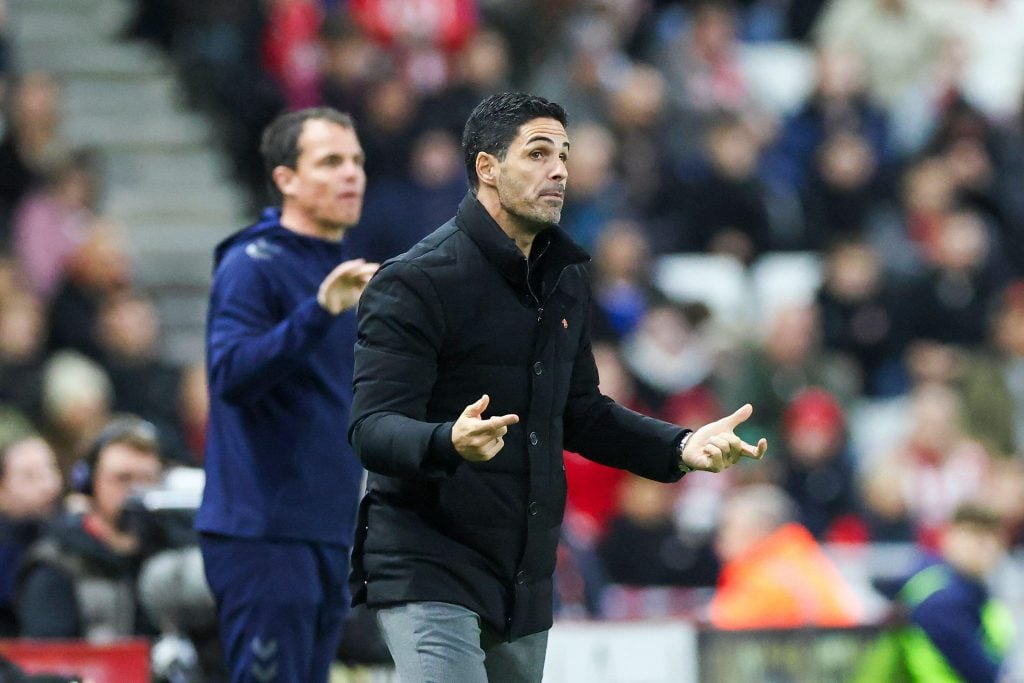
Arsenal are currently top of the 2025-26 Premier League after 11 games, winning eight, drawing twice and only losing once.
Mikel Arteta’s side have finished as runners-up in each of the past three Premier League campaigns. But they do sit top when looking at points won since the start of the 2023-24 league season.
The Gunners have shown consistency over the past few seasons and have taken an early lead in the title race in 2025-26. So, how has Arteta configured the perfect team for the current tactical landscape?
In this article, we’ll cover
Defensive foundations
Let’s kick things off by speaking about Arsenal’s defensive schemes. The Gunners’ underlying data in this particular area is quite outstanding.
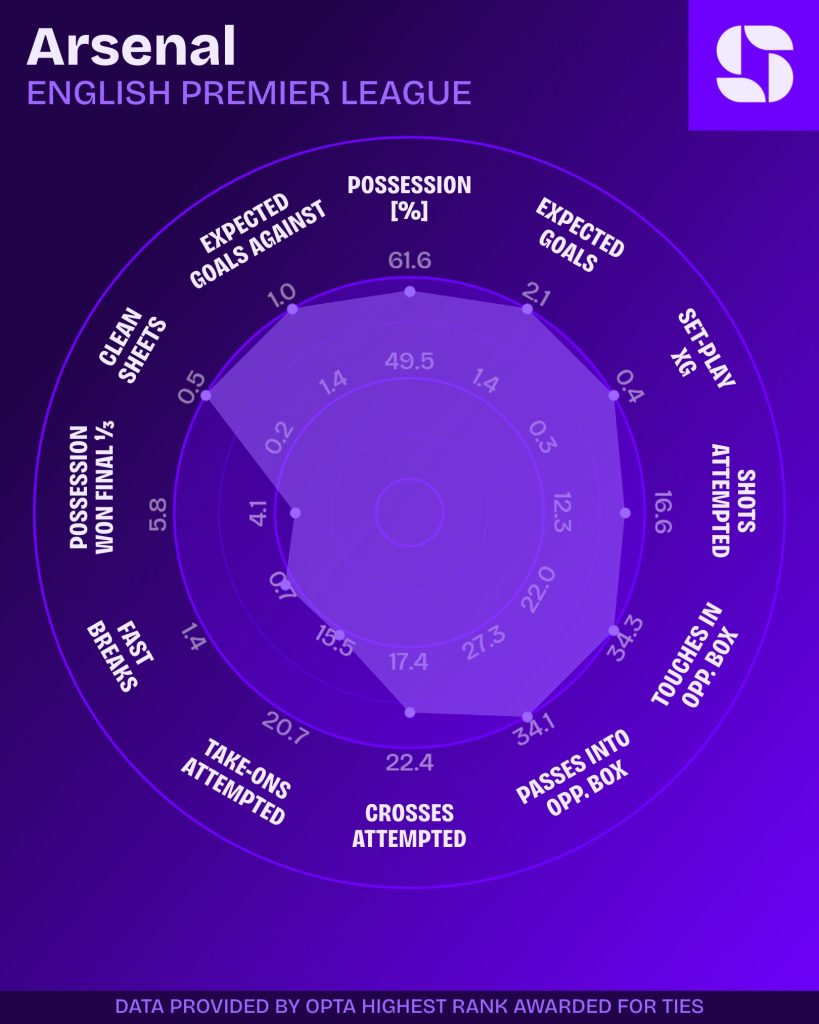
Arsenal have conceded the lowest Expected Goals so far this season with 6.14. They’ve also conceded the fewest shots per 90 minutes with 7.36 and the lowest xG per shot in the league with 0.08.
This defensive foundation has seen the Gunners only conceding five times in their opening 11 Premier League fixtures. This included an entire month without conceding a single goal in all competitions.
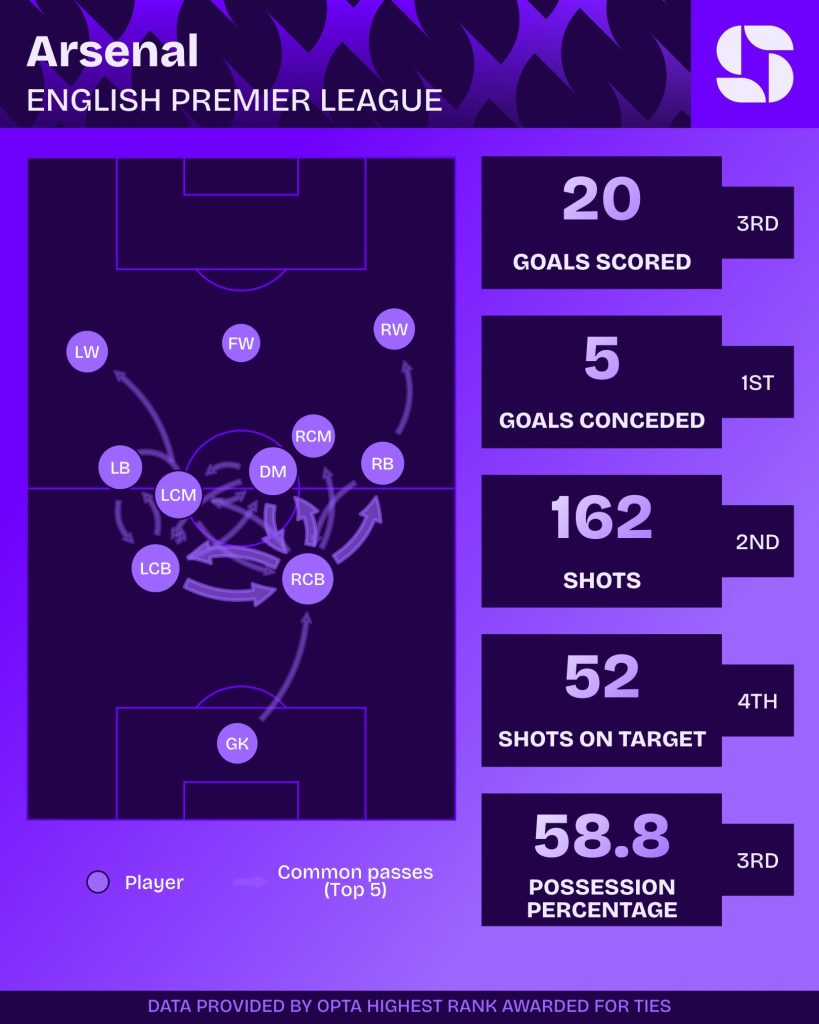
Arsenal are comfortable in all phases defensively. Whether they are pressing man-for-man in an aggressive fashion, or if they decide to sit in a more zonal midblock. Or even when they are forced to defend their own box in a lower block.
This is due to the personnel Arteta has targeted throughout the team. They have the desired physicality to win their 1v1 duels all over the pitch, while also having the intelligence to cut out passing lanes and shift between defensive schemes dependent on the opposition gameplan.
The big question now will be how Arteta is able to navigate the injury to Gabriel who could be out for up to two months. It will see Arsenal relying on their overall defensive unit to continue their solid form despite losing one of their most vital components.
Dabble sign-up offer: Bet £10+ & Receive £10 In Free Bets
Not signed up to Dabble yet? Here's how to claim the Bet £10+ & Receive £10 In Free Bets welcome offer:
- Sign up to Dabble through this link
- Register your account with accurate personal details
- Place your first bet of £10 or more
- Receive your £10 in free bets when your qualifying bet has setted
- Use your Free Bet on any eligible sportsbook market within 7 days

#AD 18+ 7-day free bet expiry. Stake not returned. Promotional Terms Apply. GambleAware.org
Build up rotations
So far this season, Arsenal are averaging 15.45 10+ pass sequences per game, with only Manchester City averaging more (16.73). They also average the second-highest volume of build up sequences per 90 with 3.73 according to Opta, with only Man City averaging more (5.55).
The addition of Martin Zubimendi has been a huge asset to Arsenal’s build up this season, along with the versatility of Ricardo Calafiori who was unable to show his true quality in 2024-25 due to injury issues.
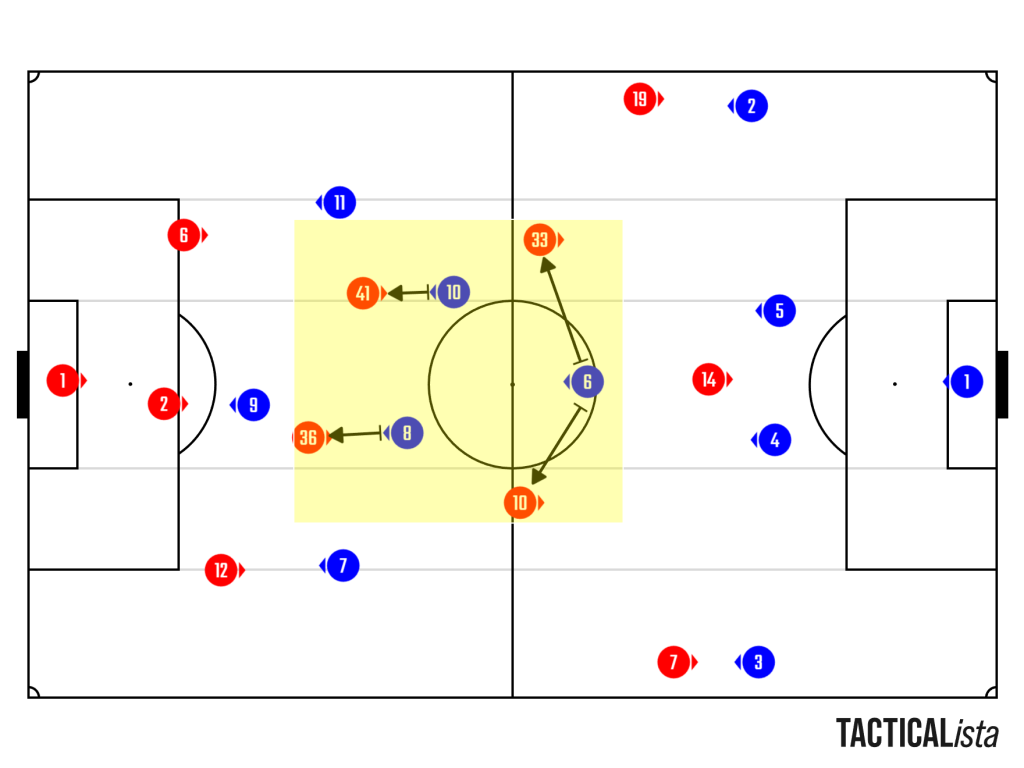
Arsenal often build in a 3-2 base which can look like a 2-3 with the positioning of Jurrien Timber varying. Calafiori’s positioning is the key though, becoming a +1 in the midfield unit to form a box midfield, overloading the opposition midfield (in this example, 4v3).
The Premier League has become a very man-to-man oriented landscape in recent years. Teams are looking to disrupt the opposition build up with high intensity pressing, leaving no “free” man to progress play.
In this example, one of the opposition centre-backs would jump out to make it a 4v4 in the middle. The defensive midfielder and one central defender then cover the interior players (pocket players) between the lines.
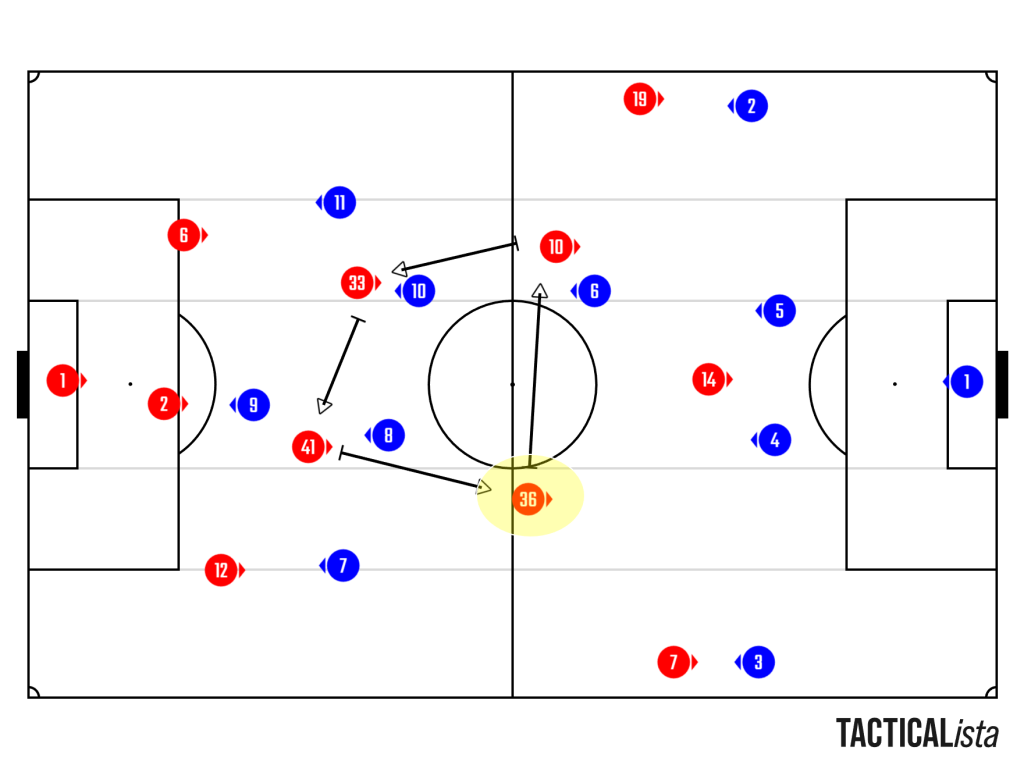
Therefore, to make it harder for the opposition press, rotations within the box midfield can afford moments of indecision for the man for man press, leading to seperation for the “spare” man (in this case, number 36, Zubimendi).
Other rotations between the full-backs and wingers have also been developing throughout the season. This is possible due to the defensive mindset of each and every player within the system, allowing them to keep their defensive solidity even with different players occupying zones that aren’t their own.
Set-pieces!
Perhaps the elephant in the room, Arsenal are very good at set-pieces. The Gunners have generated 7.17 xG from set-pieces alone this season, scoring 10 goals from them this season.
When teams are willing to sit back against you in a low block, set-pieces can be an obvious weapon to open them up, winning more set-pieces from a higher volume of shots and crosses in the match, giving them the chance to profit from their high quality set-piece routines.
Half of Arsenal’s goals have come from set-pieces this season, with only 12.34 of their xG generated coming from open play.
Arsenal look to suffocate teams inside their own half, keeping possession and moving forward as a unit in order to take their positions higher up and form a strong rest defence ready to counter press if they lose possession.
By doing this, Arteta’s men have more chances to take shots from outside the box, get crosses into the box and attack through side combinations, giving them chances to not only open lowblocks with goals in this way, but if not, win set-pieces!
Midblock solutions
So we’ve spoken about how Arsenal build up against teams pressing more man for man, and we’ve discussed one of the main tools in their kit to disassemble a lowblock, but how do they deal with something in between?
The addition of Viktor Gyokeres is the main talking point here. Many pointed towards him as the low block breaker, when in fact, he is actually more of a midblock breaker with his play style.
Gyokeres is a relentless runner, always looking to peel off the last man and make runs into the space behind the opposition defence. It’s seen Arsenal become slightly more direct this season in order to utilise his stengths.

By doing so, opposition teams are posed the question, do they look to sit in a midblock and allow space in front and, more importantly, behind their defensive unit or do they drop deeper and give Arsenal the territory and control they desire.
Gyokeres may have his own issues against a low block, which is why additions such as Eberechi Eze and Noni Madueke are also key signings from the summer. But the Sweden centre-forward will make opposition managers think twice about what spaces his side are going to give up.
What Arteta has been able to create over his tenure at Arsenal is a team capable in all phases of the game, all defensive structures and attacking ideas. By doing so, the Gunners will always be able to adapt to the opposition, handle whatever is thrown their way and eventually settle into their own game.
Their next run of games could be defining though, as they face Tottenham Hotspur, Bayern Munich and Chelsea in the next 10 days, which will give a true indicator of just how strong this Arsenal side really is.