






A first, frenetic weekend of Premier League action is over and naturally there’s a lot to talk about.
The first competitive signs after a long summer makes it very easy to jump to conclusions. We had no information to work from, now we have very little but infinitely more than we had. Therefore we can make infinitely more informed takes – right?
This assumption can be doubly true looking at gritty tactics. Ninety minutes lathered in context doesn’t realistically mean Arsenal are going to avoid “passing the football” this season. But we can only work with what we’ve got.
However, set-pieces are different. Season starts, or restarts, can bring a fresh set of tactics. Sides often use down time to maximise the stuff that will likely get left as the campaign goes on.
From just one weekend, we can build a great picture of what’s been worked on behind closed doors. And it can be summed up by Leonardo DiCaprio’s line in Inception: “We need to go deeper.”
The front post era is over
For years, the front-post contact was the meta of the corner tactic scene. You may remember the non-stop Tottenham Hotspur flick-ons to a stooped Harry Kane. The idea being that first contact decides where the play goes, and puts the defence on the back foot. So, if you secure that contact, your chance of success shoots up.
The natural defensive reaction to this is to cluster all your players at the front post, zonally, to ensure that first contact will be yours. A huge bonus if you can get your gangliest bloke there to shut that zone down. We’re looking at you, Kai Havertz.
This is where the modern attacking adaption comes in.
If a team is so focused on getting that first contact — often dedicating three or five players purely to mark the space — the best territory as an attack is… well, everywhere else. This has primarily been the back post, skipping the first click and going route one. And you can see this all across the league.
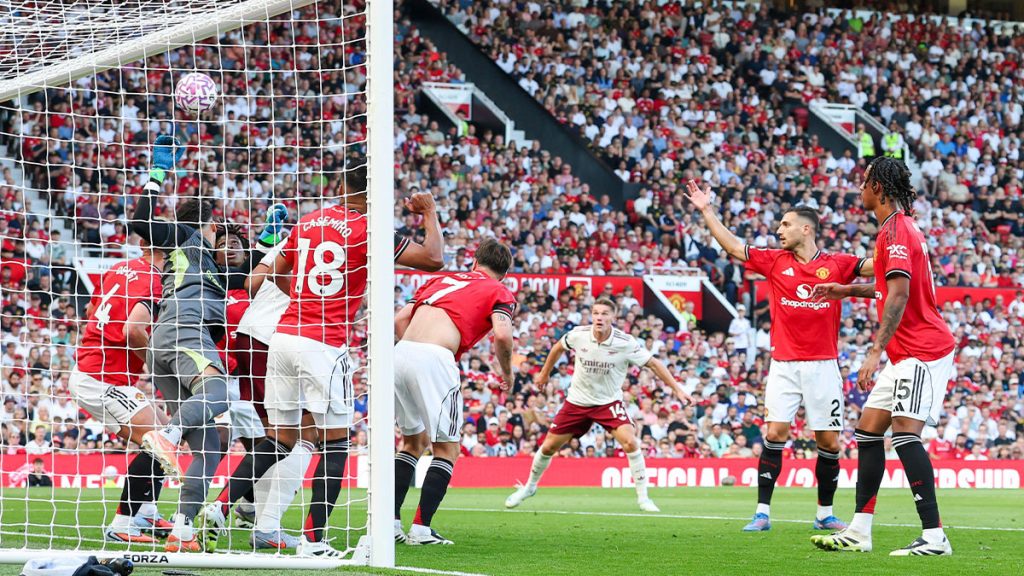
Arsenal tapped in at the far post over the top of Manchester United’s five-man structure. Chris Wood fittingly welcomed former set-piece coach Keith Andrews with a scuffed effort from the same area. Fulham used a Spursian flick-on and crash far-post tactic to savage a draw against Brighton and Hove Albion. And, most notably, Sunderland exclusively put Dan Ballard deep, isolating him behind the crowds.
If you have a powerful and giant target, the best play now is to give them a lofty ball at the back stick. Worst case scenario, you create a lovely goalmouth scramble for tap-ins. After all, everyone’s doing it.
Dabble sign-up offer: Bet £10+ & Receive £10 In Free Bets
Not signed up to Dabble yet? Here's how to claim the Bet £10+ & Receive £10 In Free Bets welcome offer:
- Sign up to Dabble through this link
- Register your account with accurate personal details
- Place your first bet of £10 or more
- Receive your £10 in free bets when your qualifying bet has setted
- Use your Free Bet on any eligible sportsbook market within 7 days

#AD 18+ 7-day free bet expiry. Stake not returned. Promotional Terms Apply. GambleAware.org
Goalkeeper contact is back, baby
It’s not all back-post. In fact, the best zone to target statistically has been the sweet spot right in front of the goalkeeper. The return of goalkeeper contact has made that all the more effective. In a big way.
Last year, you may remember the Premier League announcing that they’d be keeping a closer eye on opposition interference with goalkeepers. In a law that may as well be labelled the Hands To Yourself Benjamin Rule, the Premier League were saying “enough of that, thank you very much”. This saw a novel workaround emerge.
Scared of Benjamin White-based bullying, defensive teams typically employed a protector who would stand in the six-yard box to allow their goalkeeper to operate unimpeded. The issue here is that you’ve added another body into the zone a goalkeeper must manoeuvre past to be an effective claimer/puncher.
With this, the attacking team have an easy way out of fouling contact. And that’s to use this extra body as a meat shield: a friendly-fire cheat code. By batting the goalkeeper protector, but not engaging with the shot-stopper himself, you can block off the same space and claiming route without having to grapple him into the net. This is what William Saliba did excellently in Arsenal’s 1-0 win over Tottenham last September, for example.
However, it feels like teams have given up with the protector, noticing the above was making their job harder. And avoiding the rule change benefits entirely. But it also feels like referees have given up with the whole change too. Last weekend saw a huge return of goalkeeper contact.
The new logic is now to use the goalkeeper like the wall in a swimming pool. Pushing off at the right time to give yourself full control of the space in front of him. Micky van de Ven used this expertly to head over from six yards against Burnley, as did Joao Pedro vs Crystal Palace. Arsenal’s contact went unpunished too. All three from sides with league-leading set-piece coaches. It will be interesting to see how sides adapt to this. The two chances from Van de Ven and one from Pedro all registered over 0.20 Expected Goals. That’s hardly insignificant.
Combined, what we’re seeing is that having a deeper delivery is the key to a good set-piece play at the moment. Bad news for Man Utd that Bruno Fernandes is still taking them, then.