







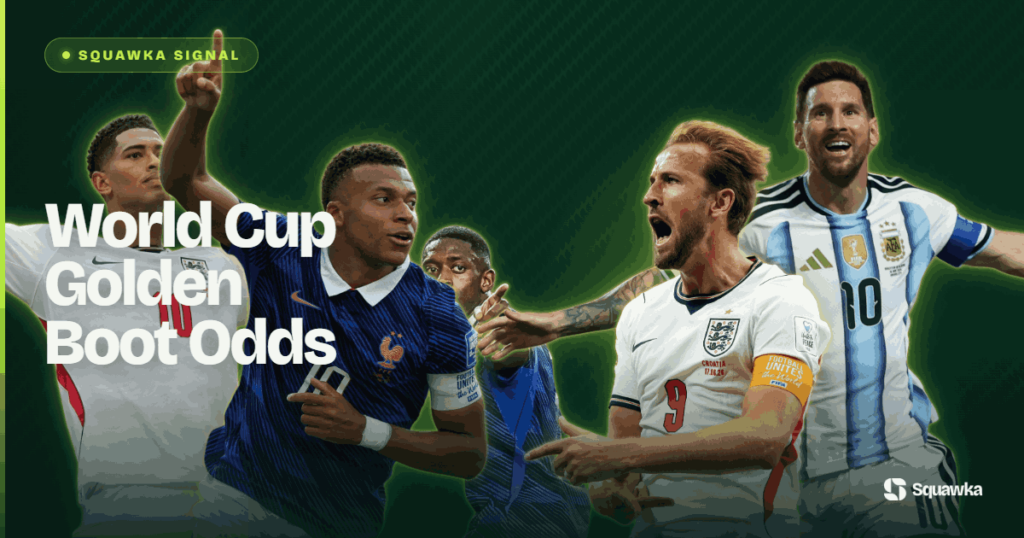
Kylian Mbappé won the World Cup 2026 Golden Boot with 10 goals — and, on 22 across three tournaments, overtook Miroslav Klose as the all-time leading World Cup scorer.
Squawka Signal called it. Through the tournament we set our own model’s top-scorer probability for every contender against the live Kalshi and Polymarket numbers — and from the group stage on, the model made Mbappé its clear favourite. Below is the final top 20, and how the model’s read matched it.
It was why a lethal finisher whose team faced an early exit could sit below a steady one in a side built to go deep. The model weighed the scoring and the schedule together, across the expanded 48-team format spread over the United States, Canada and Mexico, the deepest forward field a World Cup has carried.
World Cup 2026 Golden Boot: the final standings
Final result — updated July 20, 2026. Kylian Mbappé finished top scorer with 10 goals.
World Cup 2026 Golden Boot — final top 20
| # | Player | G | A | Min |
|---|---|---|---|---|
| 1 | K. MbappéFRA · FW | 10 | 4 | 769 |
| 2 | L. MessiARG · FW | 8 | 4 | 853 |
| 3 | J. BellinghamENG · MF | 7 | 1 | 698 |
| 4 | E. HaalandNOR · FW | 7 | 0 | 537 |
| 5 | O. DembéléFRA · FW | 6 | 2 | 648 |
| 6 | H. KaneENG · FW | 6 | 1 | 732 |
| 7 | M. OyarzabalESP · FW | 5 | 1 | 664 |
| 8 | I. SarrSEN · FW | 4 | 1 | 419 |
| 9 | J. QuiñonesMEX · FW | 4 | 1 | 440 |
| 10 | Vinícius JrBRA · FW | 4 | 1 | 505 |
| 11 | B. SakaENG · FW | 3 | 3 | 411 |
| 12 | D. UndavGER · FW | 3 | 2 | 174 |
| 13 | J. ManzambiSUI · MF | 3 | 2 | 220 |
| 14 | R. LukakuBEL · FW | 3 | 1 | 279 |
| 15 | L. MartínezARG · FW | 3 | 1 | 368 |
| 16 | C. De KetelaereBEL · FW | 3 | 1 | 385 |
| 17 | C. GakpoNED · FW | 3 | 1 | 394 |
| 18 | B. BarcolaFRA · FW | 3 | 1 | 432 |
| 19 | B. BrobbeyNED · FW | 3 | 0 | 245 |
| 20 | E. JustNZL · MF | 3 | 0 | 291 |
Squawka Signal made Mbappé its clear Golden Boot pick throughout — 99.2% to the market’s 56.5% — and he delivered. Order follows the official FIFA tiebreak: goals, then assists, then fewest minutes. For analysis and entertainment — not financial advice. Read our Kalshi review and Polymarket review.
How the Squawka Signal model works
Two things decide a player’s number. The first is how reliably he scores, which we measure by blending his actual goals with the quality of the chances he is getting, so the rate is built on what he is really doing rather than a hot or cold week. The second is how many more games his team is likely to play, drawn from our tournament-winner model: a deep run means more chances to score, an early exit means fewer.
Team strength comes from a power rating based on the chances a side creates and concedes, adjusted for opponent quality and anchored to a pre-tournament baseline before results move it. We then play the rest of the tournament out 200,000 times along the real bracket to see how often each player ends as top scorer. Reaching the semifinals matters here, because a beaten semifinalist still plays the third-place game, and those goals count.
Where our probability sits above the market price we flag value, below it overpriced, and broadly in line fair. It is analysis, not a tip, updated after every match.
What the Squawka Signal model is saying
Kylian Mbappé won the World Cup 2026 Golden Boot with 10 goals, and the Squawka Signal model had made him an even firmer favourite than the market — 99.2% to roughly 56.5%. Lionel Messi (8) finished runner-up, with Jude Bellingham and Erling Haaland (7 each) next.
The model’s conviction was vindicated: it rated Mbappé far above the market throughout, and he delivered the Golden Boot. The full final standings are above.
The pattern held to the end: the model favored forwards on teams it expected to go deep, because a deeper run meant more games and more chances to score. Mbappé’s France reached the semi-finals and the third-place game, giving him the platform his finishing turned into a record haul. It was analysis, not a tip — and this time it landed.
How the Golden Boot is decided
The World Cup Golden Boot is awarded to the tournament’s leading goal-scorer, but when multiple players finish with the same number of goals, FIFA uses a clear tiebreaker system to determine the winner.
The hierarchy is straightforward: goals scored comes first, then assists, and finally minutes played. The player with the most goals wins outright. If two or more players are tied on goals, the player with more assists takes the award. If they’re still level, the player who achieved their goals and assists in fewer minutes is crowned the winner.
This system came into play at the 2022 World Cup when Mbappe’s eight goals edged out Messi’s seven goals and three assists. It rewards not just prolific scoring but also overall attacking contribution and efficiency, making the race more nuanced than simply who scores the most.
It’s worth noting that most sportsbook “Top Scorer” markets differ slightly from the official Golden Boot. In betting markets, if players are tied, dead heat rules typically apply, meaning your stake is divided by the number of tied players and then multiplied by your odds. Always check your sportsbook’s specific dead heat rules before placing your bet.
All-Time World Cup Top Scorers
Understanding World Cup scoring history provides valuable context for what it takes to win the Golden Boot and which players have dominated the tournament across multiple editions.
The Highest Scorers in World Cup History
| Rank | Player | Country | Goals | Tournaments |
|---|---|---|---|---|
| 1 | Kylian Mbappe | France | 22 | 3 (2018-2026) |
| 2 | Lionel Messi | Argentina | 21 | 6 (2006-2026) |
| 3 | Miroslav Klose | Germany | 16 | 4 (2002-2014) |
| 4 | Ronaldo | Brazil | 15 | 4 (1994-2006) |
| 5 | Gerd Muller | West Germany | 14 | 2 (1970-1974) |
| 6 | Just Fontaine | France | 13 | 1 (1958) |
| 7 | Pele | Brazil | 12 | 4 (1958-1970) |
| 8 | Sandor Kocsis | Hungary | 11 | 1 (1954) |
| 8 | Jurgen Klinsmann | Germany | 11 | 3 (1990-1998) |
| 10 | Thomas Muller | Germany | 10 | 3 (2010-2018) |
Miroslav Klose’s record of 16 goals stood for over a decade — until 2026. Kylian Mbappé went into the tournament on 12 World Cup goals; his 10 here took him to 22, clear of Klose as the all-time leading World Cup scorer. Lionel Messi’s 8 lifted him to 21, into second on the all-time list.
Just Fontaine’s single-tournament record of 13 goals in 1958 remains untouched, though the 10 Mbappé scored in 2026 is the closest anyone has come in the modern era.
Top US scorers in World Cup history
While the United States has never produced a Golden Boot winner, several American players have made their mark on the tournament:
| Rank | Player | Goals | Tournaments |
|---|---|---|---|
| 1 | Landon Donovan | 5 | 3 (2002, 2006, 2010) |
| 2 | Clint Dempsey | 4 | 3 (2006, 2010, 2014) |
| 2 | Bert Patenaude | 4 | 1 (1930) |
| 4 | Christian Pulisic | 1 | 1 (2022) |
Landon Donovan remains the USA’s all-time World Cup top scorer with five goals, including the dramatic winner against Algeria in 2010 that sent the Americans through to the knockout rounds. Clint Dempsey scored the fastest goal of the 2014 World Cup, finding the net just 29 seconds into the match against Ghana.
Golden Boot winners by tournament
Recent World Cup tournaments have showcased diverse Golden Boot winners, from explosive young talents to experienced veterans capitalizing on their opportunities.
Recent Golden Boot Winners
| Year | Winner | Country | Goals | Runner(s)-Up |
|---|---|---|---|---|
| 2022 | Kylian Mbappe | France | 8 | Lionel Messi (7) |
| 2018 | Harry Kane | England | 6 | Antoine Griezmann (4) |
| 2014 | James Rodriguez | Colombia | 6 | Thomas Muller (5) |
| 2010 | Thomas Muller | Germany | 5 | 3 players tied (5) |
| 2006 | Miroslav Klose | Germany | 5 | Hernan Crespo (3) |
| 2002 | Ronaldo | Brazil | 8 | Rivaldo (5) |
| 1998 | Davor Suker | Croatia | 6 | Gabriel Batistuta (5) |
| 1994 | Hristo Stoichkov | Bulgaria | 6 | Oleg Salenko (6) |
| 1990 | Salvatore Schillaci | Italy | 6 | Tomas Skuhravy (5) |
| 1986 | Gary Lineker | England | 6 | Careca, Diego Maradona (5) |
The historical data shows that 5-6 goals typically wins the Golden Boot, with 7-8 goals being exceptional. The 2026 tournament’s expanded format could push these numbers slightly higher, as teams advancing to the final will play eight matches instead of seven.
USA players who could challenge for the Golden Boot
The United States are out of the World Cup 2026, so this year’s Golden Boot will be settled among the forwards still standing — but home soil still gave the USMNT their best platform yet to produce a genuine contender.
In the end, no American forward featured among the tournament’s leading scorers. Christian Pulisic remained the USMNT’s most likely source, but neither he nor Folarin Balogun nor Ricardo Pepi put together the run and the goal haul a Golden Boot challenge needs. The model had priced that honestly all along, rather than on home-crowd optimism.
Frequently asked questions (FAQs) about the World Cup top scorer
Kylian Mbappé is the all-time World Cup top scorer with 22 goals across three tournaments (2018-2026), having overtaken Miroslav Klose (16) at the 2026 finals. Lionel Messi is second on 21, with Klose third.
Kylian Mbappe won the 2022 Golden Boot with eight goals, including a hat-trick in the final against Argentina. He edged out Lionel Messi, who finished with seven goals and three assists.
The Golden Boot goes to the player with the most goals. If players are tied, the tiebreaker is assists, then minutes played. The player with fewer minutes wins if goals and assists are equal.
Kylian Mbappé won the 2026 World Cup Golden Boot with 10 goals and 4 assists, ahead of Lionel Messi (8 goals, 4 assists). It was the Squawka Signal model’s clear pick throughout the tournament.
No American player has ever won the World Cup Golden Boot. Landon Donovan’s five goals across three tournaments (2002, 2006, 2010) remains the USA’s best performance, with his three goals in 2010 representing the highest single-tournament total for an American in the modern era.
Yes. Regulated prediction markets Kalshi and Polymarket both list World Cup top-scorer contracts for US users, pricing each player as an implied probability you can trade. Squawka Signal compares those live prices with our own model so you can see which look like value and which look overpriced.
The terms are essentially the same—Golden Boot is the official FIFA award name for the tournament’s top scorer. However, in betting markets, “Top Scorer” markets may use dead heat rules if players tie, while the official Golden Boot uses assists and minutes played as tiebreakers.
Historical data shows that 5-6 goals typically wins the Golden Boot, with 7-8 goals being exceptional. The range varies significantly by tournament—Just Fontaine’s record of 13 goals in 1958 remains untouched, while some tournaments have been won with as few as four goals. The 2026 expanded format may push the winning total slightly higher.
Remember to bet responsibly. If you or someone you know has a gambling problem, call 1-800-GAMBLER or visit the National Council on Problem Gambling at ncpgambling.org.