




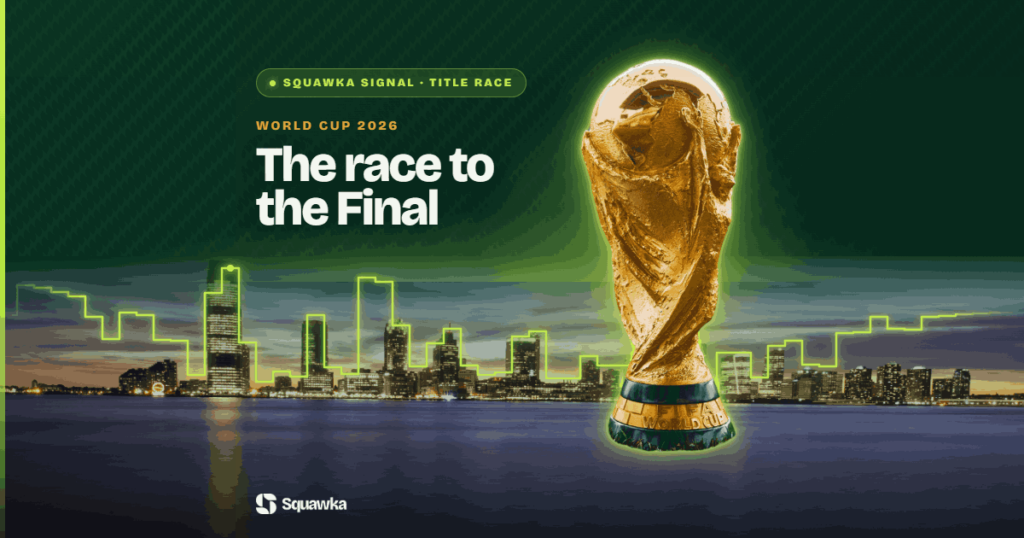
Spain are the 2026 World Cup champions, beating holders Argentina 1–0 after extra time in the final. Here is how the tournament finished — and how the Squawka Signal model’s season-long read held up.
World Cup 2026 winner: how the Squawka Signal model called it
Final result — updated July 20, 2026, after Spain beat Argentina in the final.
Spain lifted the trophy, and the Squawka Signal model had them at the top of its list from the group stage on. Through the tournament, Signal set our own model’s title probability for every nation against the live Kalshi and Polymarket prices. Below is the final picture: how the tournament finished, and how the model’s read matched it.
The gaps were the point. Reputation and recent history set the market; our model weighed the route each nation actually had to navigate. In the end, Signal’s two most-backed contenders, Spain and Argentina, were the two who reached the final. For the top-scorer race, see our World Cup 2026 Golden Boot page.
World Cup 2026 — final standings
Model verdict reflects each nation’s title probability entering the knockout rounds, from 50,000 simulations of the bracket — where Spain (15.5%) and Argentina (14.8%) led the field. For analysis and entertainment — not financial advice. Read our Kalshi review and Polymarket review.
How the Squawka Signal model works
Squawka Signal is built on a power rating for every team, drawn from the quality of the chances they create and concede rather than results alone, and adjusted for the strength of the opponent so that beating a weak side counts for less than beating a strong one. Each rating is anchored to a sensible pre-tournament baseline, then moves with every match played.
To turn those ratings into a win probability, we play the rest of the tournament out 50,000 times along the real bracket, with the stronger team more likely to win each tie but upsets always in play. The share of those simulations a team wins is its probability. Because the model knows the actual draw, it captures what a flat ranking cannot: a strong side stuck in a loaded half is rated on its real path, not its reputation.
The verdict on each price follows from there. Where our number sits above the market we flag value, where it sits below we flag overpriced, and where the two broadly agree we call it fair. This is analysis, not a tip, and the market can be right where we are wrong. It is one honest, transparent read, updated after every result.
What the Squawka Signal model got right
The Squawka Signal model backed Spain and Argentina as its top two entering the knockouts — and both went all the way to the final.
Spain, the model’s No.1 pick, won it; Argentina, its No.2, were beaten finalists. The model’s read on where each price sat against its own number is preserved above.
The pattern held to the end: the model backed the nations built to survive a deep bracket, not simply the biggest names, because the route to the final counted for as much as reputation. Spain and Argentina navigated it; both semi-finals, Spain past France and Argentina past England, went the way of the model’s more-favoured side. It was analysis, not a tip — and this time it landed.
Who won the World Cup 2026? The Squawka Signal verdict
The Squawka Signal model made Spain its No.1 pick, and Spain delivered — beating Argentina, the model’s No.2, 1–0 after extra time to lift the trophy. See how the knockouts unfolded in our World Cup 2026 bracket and the full story of the showpiece in our World Cup 2026 final predictions.
Hosts in the market
All three host nations are now out, and the market still treats them as outsiders against the European and South American elite — the honest read on where they stand, even with home crowds behind them.
United States
United States are out of the World Cup, so the winner market has moved on from them.
Mexico
Mexico are out of the World Cup, so the winner market has moved on from them.
Canada
Canada are out of the World Cup, so the winner market has moved on from them.
How the bracket shapes the market
The knockout draw was where our model and the market most often parted company. A side handed a kind route can be worth backing below its reputation; a glamour name drawn into a loaded half can be worth taking on, however strong the squad — because the bracket a team actually has to navigate counts for as much as the badge. That is the basis of the Squawka Signal read above. Full coverage of the draw and schedule sits on the World Cup 2026 hub and the schedule.
Other World Cup 2026 outright markets
Beyond the outright winner, the World Cup carried a full set of outright markets:
- Outright winner (this page)
- Golden Boot (top goalscorer) — tracked on our Golden Boot odds page
- Golden Ball (best player)
- Group winners (12 separate markets, one per group)
- Stage of elimination (group, R32, R16, QF, SF, runner-up, winner)
World Cup 2026 FAQs
The 2026 FIFA World Cup started on June 11, 2026 with the opening match at the Estadio Azteca in Mexico City. The 48-team tournament is staged across the United States, Canada and Mexico and concludes with the final on July 19, 2026 at MetLife Stadium.
Spain won the 2026 World Cup, beating defending champions Argentina 1–0 after extra time in the final at MetLife Stadium, with Ferran Torres scoring the decisive goal. It was the outcome the Squawka Signal model had pointed to: Spain and Argentina were its two most-backed nations entering the knockout rounds.
The 2026 World Cup expands to 48 teams in 12 groups of four. The top two from each group plus the eight best third-placed teams advance to a 32-team knockout round, which then runs round of 32, round of 16, quarter-finals, semi-finals and final.
Under the new 48-team format the winner plays eight matches: three in the group stage, then four knockout rounds through to the final, having entered the expanded round of 32.
US coverage runs across FOX and Telemundo, with streaming on their associated platforms. Check the World Cup 2026 hub for the latest broadcast and streaming details closer to kick-off.
Must be 21+. GAMBLING PROBLEM? Call 1-800-GAMBLER. Odds approximate at time of writing.