








Spain have won the 2026 World Cup after a 1-0 win over Argentina at the MetLife Stadium in New Jersey.
It was substitute Ferran Torres with the decisive finish in the 106th minute, as the Europeans were finally rewarded for their possessional dominance of what was largely a cagey affair.
Across the opening 90 minutes, it was a game of few chances. Only once before had a World Cup final been goalless at the end of normal time, back in USA 1994, and history repeated itself again here.
The game was stop-start, as was expected by many, with Argentina using all of their street-smarts to stifle Spain’s possession dominance. But the drama ignited in the final moments of normal time.
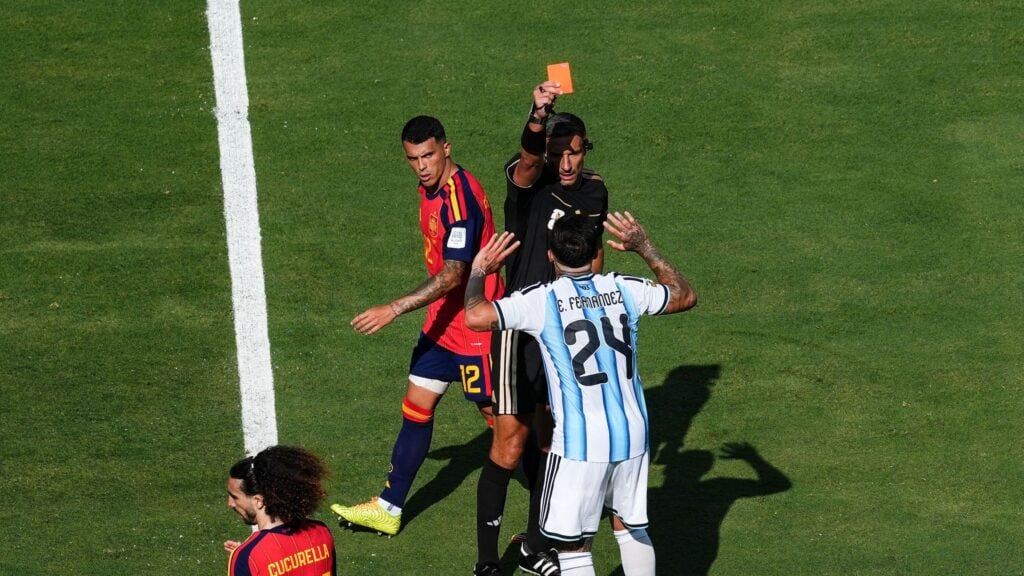
Enzo Fernandez became the sixth player ever to be sent off in a World Cup final: and 50% of those have been issued to Argentina. The Chelsea midfielder could have few complaints. Having been booked for dissent, Fernandez flew wilding into a reckless challenge on Pau Cubarsi to receive his second yellow just minutes before the 90 minutes was up.
And the 10-men required a strong save from Emi Martinez to deny Spain a late winner in normal time, with the Argentine goalkeeper at full-stretch to deny Lamine Yamal’s freekick in stoppage time.
Martinez was called on again in the opening exchanges of extra time. Pedro Porro’s whipped cross was flicked on my Nico Williams, but again Martinez was there to keep it out.
Nico Williams had the ball in the net moments later, only for the goal to be ruled out for an alleged foul from Mikel Merino on Nicolas Otamendi. It looked a contentious decision to say the least, but clearly not significant enough for VAR to intervene.
Spain’s dominance continued, but so did the match, with the score goalless at the game entered the second period of extra time.
Europe’s The Final Countdown blared out from the speakers during the interval. It was either an omen for the Europeans or a warning to Spain that possession is only nine-tenths of the law.
It proved to be the former.
Seconds after the restarts, substitute Ferran Torres fired Spain in front. The Barcelona forward was quickest to react as Nico Williams kept the ball alive at the back-post with a flicked header.
Martinez was finally beaten, and so were the holders.
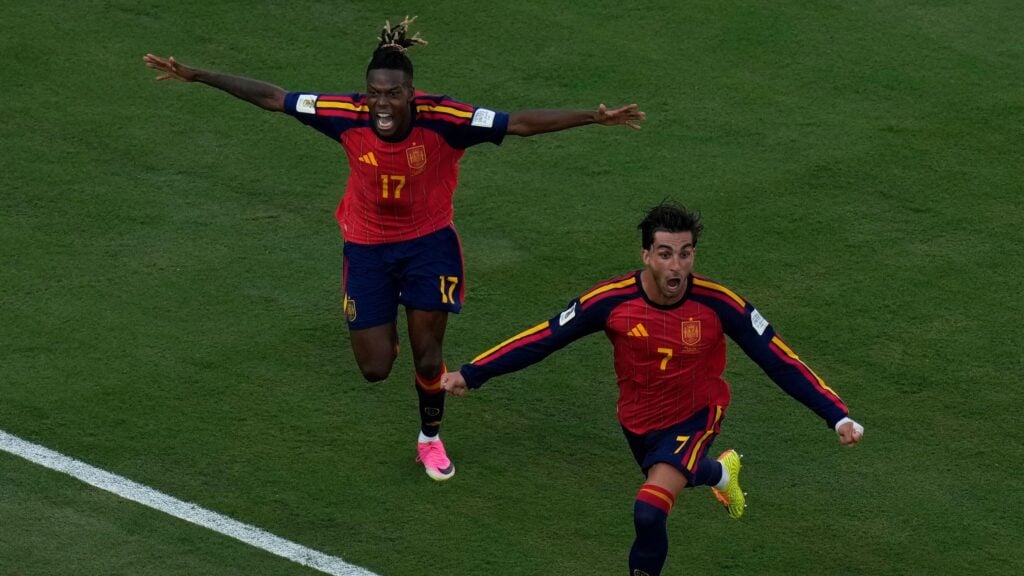
Conceding the goal sparked attacking threat into Argentina for the first time in the match, with the South Americans going close through Marcos Senesi in the closing moments.
But it was too little, too late. Spain were crowned World Cup champions for just the second time in their history, having won their first back in 2010 in South Africa.
The Signal verdict: how they stacked up coming into the final
How they stacked up going into the final
Squawka Signal is our in-house model — an opponent-adjusted rating system with a 50,000-run Monte Carlo simulation of the final. Figures reflect its read going into kick-off.
Squawka Signal made Spain the favourite at 58%, rating them the strongest side left in the tournament (SPI 89.5 to Argentina’s 86.0) and projecting a tight 1.3–1.0 scoreline — a reflection of the meanest defence in the competition. Argentina, powered by Messi’s eight goals, were given a live 42% puncher’s chance. {{UPDATE post-match: did the result follow the model or defy it?}}
How they got here
Spain’s road to the final
- Group stage: 0–0 v Cape Verde, 4–0 v Saudi Arabia, 1–0 v Uruguay (topped the group, 2 wins and a draw)
- Round of 32: 3–0 v Austria
- Round of 16: 1–0 v Portugal
- Quarter-final: 2–1 v Belgium
- Semi-final: 2–0 v France
Spain arrived as the tournament’s form team and played like it. They came through their group without alarm — a goalless afternoon against Cape Verde aside, they put four past Saudi Arabia and saw off Uruguay — then turned the knockouts into a procession. Austria were brushed aside 3–0, Portugal edged out by a single goal, Belgium beaten 2–1 and France dismantled 2–0 in the semi-final. One goal conceded across four knockout ties tells the story: this is the meanest defence in the competition, and it has carried them to MetLife without ever looking like buckling.
Argentina’s road to the final
- Group stage: 3–0 v Algeria, 2–0 v Austria, 3–1 v Jordan (three wins from three)
- Round of 32: 3–2 v Cape Verde (after extra time; 1–1 at 90)
- Round of 16: 3–2 v Egypt
- Quarter-final: 3–1 v Switzerland (after extra time; 1–1 at 90)
- Semi-final: 2–1 v England
Argentina had taken the hard road. Three wins from three in the group stage — Algeria, Austria and Jordan all beaten — gave way to a knockout run that kept going to the wire. They needed extra time to shake off Cape Verde in the last 32 and again to see off Switzerland in the quarter-finals, pegged back to 1–1 on both nights, with a 3–2 win over Egypt in between. The reward was a semi-final against England, settled 2–1. Through all of it Lionel Messi has been the constant, his eight goals dragging Argentina to within a game of another world title.