








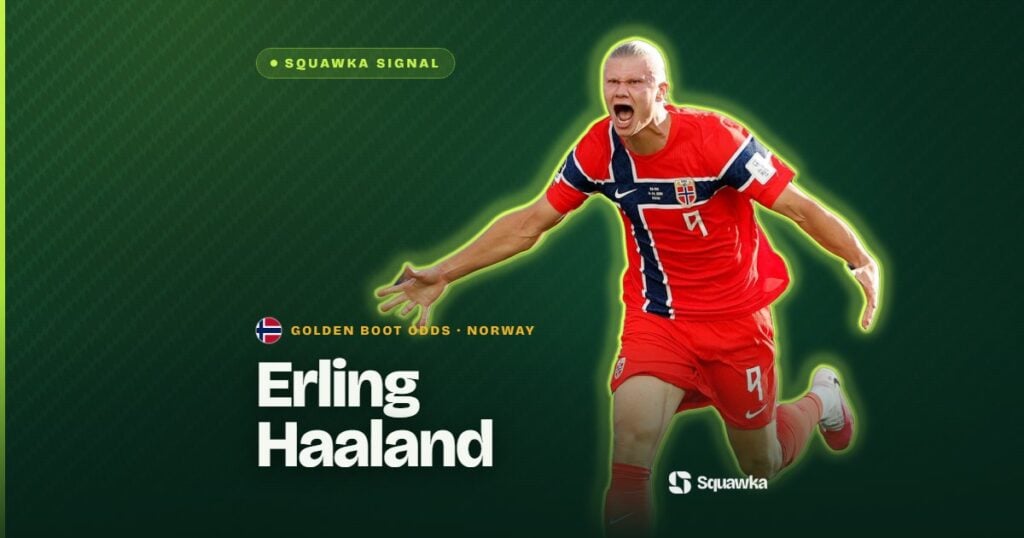
Erling Haaland’s Golden Boot odds sit right on top of the Squawka Signal, even as the two prediction markets pull in opposite directions. Four goals into Norway’s World Cup, from an expected-goals figure of 3.6, our model puts Haaland at a 5.2% chance of finishing as the tournament’s top scorer. That is our own number, before the market gets a vote.
Set it against the prices and the markets split. Kalshi has him at 4.0%, a shade under our read, while Polymarket sits higher at 6.5%. The blended price lands almost exactly on our 5.2%, which is why the Signal calls him fair, but the two books clearly disagree with each other.
Prediction markets · 21+ where available, eligibility varies by US state · not financial advice. Kalshi review · Polymarket review
Erling Haaland’s Golden Boot Odds: What the Squawka Signal Says
The headline figure is 5.2%, and the badge reads fair, level to the decimal. The model sits between the two markets rather than on either, so there is no clean edge to chase, only a question of which book you believe.
What stands out is the quality underneath the number. Haaland’s expected-goals figure is the highest of any chaser on the board, so the model trusts his scoring more than most. The reason he is not higher than 5.2% has nothing to do with whether the goals are real, and everything to do with how many more games he will get.
Erling Haaland’s World Cup 2026 Goal Tally So Far
The goals column says four, from an expected-goals figure of 3.6. That is the most convincing underlying return of anyone in the chasing pack: Haaland is not riding a hot streak, he is scoring roughly in line with chances that are themselves excellent.
That is exactly the profile the Signal rewards. Rather than fade a finishing run, the model blends goals with chance quality, and Haaland’s numbers hold up under that test better than any rival’s. On scoring alone, he would carry a higher number.
Squawka Signal vs Kalshi and Polymarket
Here the two markets part ways. The Squawka Signal has Haaland at 5.2%. Kalshi reads 4.0%, a touch under the model, while Polymarket has him at 6.5%, a little over.
The model splits the difference, which is why the badge says fair. If there is an edge, it is small and it depends on the book: Kalshi’s 4.0% is the cheaper way in, Polymarket’s 6.5% the richer. With the blended price level on our number, the next move comes from results, and specifically from how far Norway go.
Does Norway’s Run Help or Hurt Erling Haaland’s Golden Boot Chances?
This is where Haaland’s number is capped, and it is not about his finishing. His expected-games figure is just 1.9, the shortest runway of any contender in the top six, because Norway are the leading name’s side most exposed to an early exit.
The logic is central to how the Signal works. A lethal finisher on a side facing a tough route will score fewer than a steadier one on a team built to go deep. The model rates every team on the chances they create and concede, adjusted for the opponent, then maps the bracket round by round. For Haaland, the single biggest swing is not his scoring rate, which is excellent; it is whether Norway give him more than the two games or so the model expects.
Erling Haaland’s Golden Boot Rivals on the Squawka Signal
Haaland is not chasing this market alone. The Squawka Signal list below shows where Haaland sits in the wider Golden Boot picture, refreshed after every match.
| Player | Goals | Squawka Signal |
|---|---|---|
| Lionel Messi (Argentina) | 6 | 68.0% |
| Kylian Mbappe (France) | 4 | 9.7% |
| Ousmane Dembele (France) | 4 | 5.5% |
| Erling Haaland (Norway) | 4 | 4.5% |
| Harry Kane (England) | 3 | 3.7% |
| Vinicius Junior (Brazil) | 4 | 3.3% |
For the full field, contender tiers and how the market is pricing the rest, see our World Cup 2026 Golden Boot odds tracker.
How the Squawka Signal Works
The Golden Boot is the World Cup’s quietest drama, a race that can swing on a single knockout tie, and the prices attached to it are often a step behind the reasons. Squawka Signal is our read on each player’s chance of finishing as top scorer, held against the live Kalshi and Polymarket prices. Where the two disagree is where it gets interesting.
Two things decide a player’s number. The first is how reliably he scores. Rather than lean on a hot week or punish a quiet one, we blend his actual goals with the quality of his chances — his expected goals — so the rate rests on what he’s really doing, not just what has landed.
The second is how many more games he’ll play, and it’s where most prices go astray. A lethal finisher bound for an early exit scores fewer than a steady one in a side built to go deep. So we rate every team on the chances they create and concede, adjusted for opponent quality, and anchor each to a pre-tournament baseline before results pull it up or down.
From there we map the real bracket: the route a team faces, round by round, and how likely they are to come through each one. It’s why a player in the tougher half carries a lower number than his reputation suggests, and why a deep run matters: a beaten semifinalist still plays the third-place game. We then play the tournament out 200,000 times to turn it into a single probability.
Set that against the market price and you have the Signal: value where the market is too low, overpriced where it’s too high. Because every result feeds back in, the picture moves with the tournament, ratings shift and contenders climb or fade each round.
Erling Haaland Golden Boot Odds FAQs
The Squawka Signal puts his top-scorer probability at 5.2%. The markets split around it, with Kalshi at 4.0% and Polymarket at 6.5%, so the blended price is rated fair.
5.2%. The Signal blends his goals and a strong expected-goals figure with Norway’s short projected run, then simulates the rest of the tournament 200,000 times.
There is no clean edge. The model lands between the two markets, so Kalshi’s 4.0% is the cheaper entry and Polymarket’s 6.5% the richer, with the blended price fair.
Four, from an expected-goals figure of 3.6, the most convincing underlying return among the chasing pack.
At the final on July 19, 2026. Goals scored in the third-place game count, so a beaten semifinalist can still add to their tally.