



Paying a casino from your phone bill is the lightest deposit there is: no card, no bank detail, no account to fund first, one SMS. So it is worth asking why carrier billing deposits never became a mainstream Canadian option. The answer is two structural limits, and the second deserves more attention than it gets.
What happens at the cashier
You pick the pay-by-phone option, enter an amount, and confirm by SMS or in an app. The charge routes through a carrier-billing service, Boku and Zimpler being the names Canadians meet most, and lands either on your next phone bill or against your prepaid credit. The deposit itself credits instantly.
Nothing about your bank or card reaches the casino, which is the privacy case, and there is no wallet to top up first, which is the convenience case. Both hold up. Our pay by phone casino guide tracks which Canadian cashiers carry it, and the answer is fewer than you would expect.
Why the caps sit where they do
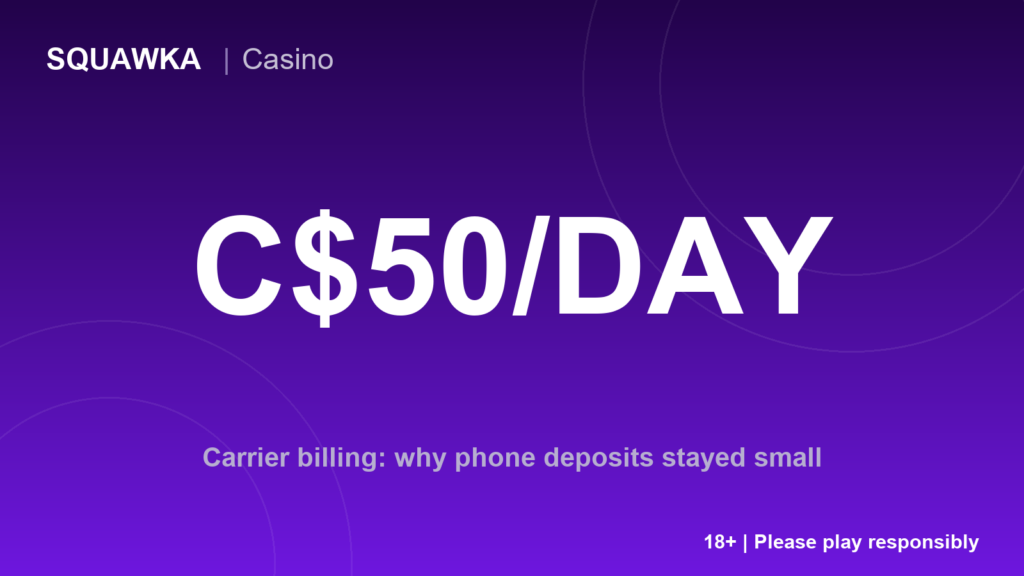
Carrier billing was built for small digital purchases, the kind where a couple of dollars on a phone bill is the whole transaction. That heritage sets the ceiling. Casino deposits through the rail are commonly capped around C$30 to C$50 a day, and the cap comes from the carrier and the billing service rather than the casino.
A cap that low decides the role for you. It is enough for a small session, not enough to be anyone’s primary rail, and awkward against a welcome offer that expects a larger qualifying deposit. Add that support varies by provider and plan, and the niche explains itself: a method that works sometimes, for small amounts, at a minority of sites.
That is a boundary rather than a fault.
The bill you have not paid yet
Now the part most guides skip. A deposit charged to a monthly phone bill is money you have not paid at the moment you gamble it. The account settles weeks later, which makes a postpaid carrier deposit a small credit arrangement, whatever it looks like in the cashier.
Gambling with money you have not yet paid is the pattern responsible-gambling guidance warns about, and it is the same objection that applies to funding a casino with a credit card, which our piece on why your bank might block a casino deposit covers from the banking side. A prepaid balance sidesteps the problem completely, because the credit is already spent and the ceiling is the balance. If you use this method, prepaid is the version that keeps a budget honest, and our gambling awareness page is worth a read.
One way only
Carrier billing moves money onto a phone account and cannot move it back off, so payouts arrive by another method. That puts it in the same category as a prepaid voucher: a front door with no matching exit.
The routine is the same as for vouchers. Choose the withdrawal rail before the first deposit, usually Interac in Canada, and verify identity early so a first payout is not held while documents are reviewed. Our KYC and pending periods guide covers where the waiting comes from.
Where it still earns its place
Two situations, and in both the cap is doing useful work. The first is a small deposit, where the method matches the amount and the daily ceiling enforces a budget you might otherwise talk yourself out of. Our minimum deposit casino guide covers what small deposits buy and where the floors bite.
The second is a player who wants no card and no bank detail anywhere near a cashier, and who is content to be paid out elsewhere. That is a legitimate preference, and carrier billing serves it with less friction than a trip to a shop for a voucher.
When your provider does not support it
Support depends on two things lining up: your carrier and plan on one side, the casino’s cashier on the other. Canadian coverage is patchy on both, so the method is best treated as a bonus if it appears rather than something to plan a deposit around.
Prepaid plans are the more reliable half of the picture, because the balance is already loaded and the charge cannot exceed it. Postpaid accounts carry the credit problem described above. And if the option is missing from the cashier altogether, Interac is the rail effectively every casino serving Canadians carries, at no cost and in both directions.
The fee question, and the bonus question
Costs vary by provider rather than by casino, and a carrier or service charge is common, so the provider is the place to check rather than the cashier. On a deposit capped near C$30, even a modest fixed charge is a poor ratio, which is the same arithmetic that makes small deposits expensive across every method.
Bonuses are the other catch. Welcome offers frequently expect a qualifying deposit above the daily carrier cap, so the method can quietly disqualify you from the offer you signed up for. Check the terms first. If the offer matters more than the convenience, deposit another way.
The wallet cousins that can pay out
Phone-linked wallets overlap this category and get mistaken for it constantly. MuchBetter pairs to a device the way carrier billing does, but it holds a balance and can pay you back, which makes it a two-way method with a phone-shaped interface rather than a carrier product at all.
If what appealed to you was approving a deposit on your phone, a wallet gets you that without the one-way limit and without the daily ceiling. The full set of options, ranked by what each is good at, sits on our casino payment methods hub, and the brands themselves are on the main casino list.
Commonly around C$30 to C$50 a day. The cap is set by the carrier and the billing service rather than the casino, and it reflects a rail built for small digital purchases.
No. Carrier billing only moves money onto a phone account, so payouts arrive by another method. Interac is the usual Canadian choice.
No. Carrier billing charges your phone account and cannot pay out. A phone-linked wallet such as MuchBetter holds a balance and can pay you back.
Often not, because the daily cap sits below the qualifying deposit many welcome offers expect. Check the offer terms before depositing this way.
19+ (18+ in AB/MB/QC) | Please play responsibly | ConnexOntario: 1-866-531-2600 (ON). See your province’s helpline for resources elsewhere.