




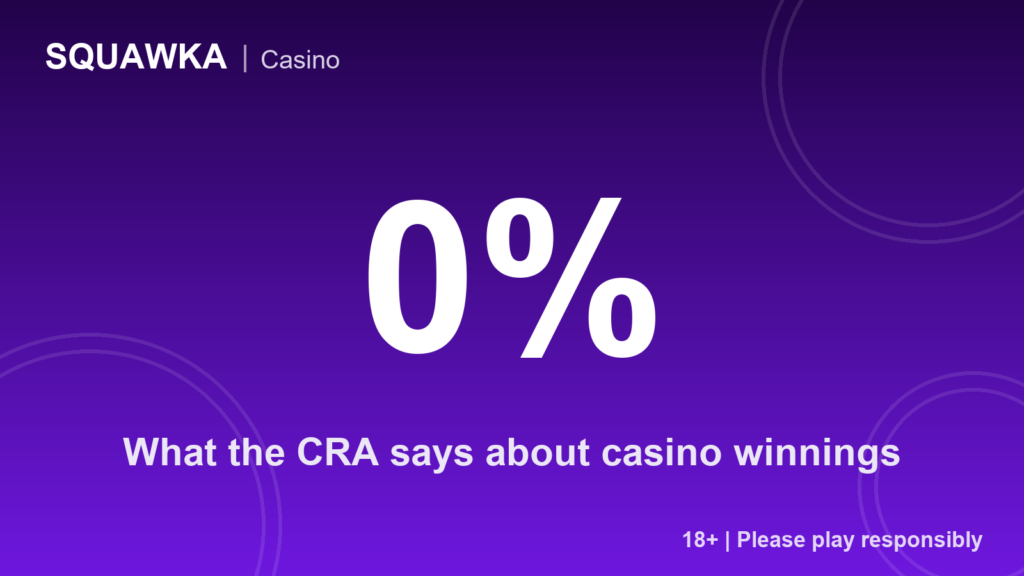
For almost every Canadian who plays at the best online casinos in Canada, the answer is the good one: casino winnings are not taxed, not reported, and not the CRA’s business. That has been true for decades. What changed recently is the other end of the spectrum, where Canada’s courts have finally drawn a real line for professional players.
This guide explains both halves, the handful of situations where tax genuinely applies, and what any of it means for your records. It is general information rather than tax advice, and anyone with serious money in play should talk to an accountant.
The windfall principle: why wins aren’t taxed
Canadian tax law only taxes income that comes from a source, such as employment, business or property. A recreational gambling win has no source in that sense. You had no enforceable claim to it, no organized effort behind it and no reasonable expectation it would recur, which makes it a windfall, a category the courts settled in a 1982 Federal Court of Appeal case called Cranswick.
The CRA administers this through its income tax folio on lottery winnings and miscellaneous receipts, which says plainly that gambling, even regular, frequent and systematic gambling, is not generally regarded as a commercial activity except in very exceptional circumstances. The Income Tax Act backs the door shut from the capital-gains side too, deeming no taxable gain on the disposition of a chance to win a prize. The practical upshot is simple: a recreational win, whether it is $40 or a seven-figure jackpot, does not go on your return at all.
The professional-gambler exception
The exception is carrying on a business of gambling, and for years it was close to theoretical. The Supreme Court’s test asks whether the activity is run in a sufficiently commercial way, with system, skill and risk management rather than hope. Wanting to win proves nothing, since every gambler wants to win, and even winning proves nothing by itself.
The case law shows how high the bar sits. In 2006, two brothers who had netted millions from government sports lotteries, betting hundreds of thousands a week with helpers and software, were held not taxable, because volume alone is not a system that beats chance. In 2022, the Tax Court reached the same conclusion about Jonathan Duhamel, the Quebec poker player who won the World Series of Poker main event: his millions were not business income, because the Crown could not show a method that actually managed the risk, and the CRA did not appeal.
Then the line moved. In a trilogy of decisions between 2022 and 2023, the Tax Court found three full-time Quebec online poker players taxable on millions in winnings, and the Federal Court of Appeal affirmed it in 2025. The Supreme Court refused to hear the players’ appeal in June 2026, which makes it settled law. What separated them from Duhamel was the shape of a business: poker as sole livelihood, full-time hours over years, consistent profits, and structured, software-assisted risk management. For a small group of genuine professionals, the CRA now wins these cases. For everyone else, nothing has changed.
Where tax does apply
Three real cases are worth knowing. First, income earned on winnings is ordinary taxable income: the win itself is tax-free, but the interest, dividends or gains it produces once invested are taxed like any other money, and the CRA’s own guidance says exactly that. Second, prize property is treated as acquired at its fair market value, so if a prize appreciates and you later sell it, the growth is taxable.
Third, the United States plays by different rules. American casinos withhold 30 percent from a Canadian’s slot or lottery-style winnings and issue a form recording it. Some of that is recoverable: under the Canada-US tax treaty you can file a US non-resident return, offset same-year US gambling losses against the winnings, and claim back the difference, a process that needs a US tax number and solid win-loss records. Table-game winnings from blackjack, baccarat, craps and roulette are generally exempt from the withholding for recreational players. There is no Canadian credit for the US tax, because Canada never taxed the win in the first place.
Crypto wins: the extra layer
Winnings paid in cryptocurrency add a second layer that catches people out. The win itself is a windfall like any other, whatever the currency. But the coins you receive are property in the CRA’s eyes, acquired at their value on the day they arrived, and everything after that is ordinary crypto tax. Sell them, swap them for another coin or spend them, and you have a disposition, with a capital gain or loss measured from that day-one value. Half of a gain is taxable at your marginal rate. A player paid one Bitcoin tax-free who cashes it out after a strong run can owe real tax on the growth alone, which is worth understanding before choosing crypto casino play over dollars.
Record-keeping: when to bother
A recreational player usually needs no records for the CRA. Keep them anyway in three situations. Large wins attract source-of-funds questions from banks and casinos, and a dated record of the win answers them in minutes when withdrawing your winnings. Anyone reclaiming US withholding needs win-loss documentation for the same calendar year, since the refund rests on it. And anyone whose play looks even faintly professional, full-time hours, consistent profits, gambling as the main income, should keep everything and get proper advice, because that is the territory the courts have now mapped against players.
Interest and investment income on winnings should be tracked from the start too, since that part was never tax-free.
No, not as a recreational player. Winnings are windfalls with no income source attached, so they are not taxable and do not go on your return.
No. Recreational gambling winnings are not reported at all. Only the income they later earn, such as interest once invested, is reported and taxed.
They can be now. After a trilogy of Tax Court decisions was affirmed on appeal in 2025, with the Supreme Court refusing leave in 2026, full-time players with systematic risk management and consistent profits are taxable on winnings as business income. Recreational players are unaffected.
Yes. US casinos withhold 30 percent from most non-table winnings. Canadians can recover some or all of it by filing a US non-resident return and offsetting same-year US gambling losses under the tax treaty.
This article is general information, not tax advice. Speak to a qualified accountant about your own situation.
19+ (18+ in AB/MB/QC) | Please play responsibly | ConnexOntario: 1-866-531-2600 (ON). See your province’s helpline for resources elsewhere.